 Ongoing
Via Alloro 95, Palermo — former Museo della Scuola, Kalsa · 2025
- Sito
- orbitapalermo.it
- Launched
- 20 April 2025 (Collaboration Pact approved, Council Resolution no. 31)
- Location
- Via Alloro 95, Palermo — former Museo della Scuola, Kalsa
- Opening
- 3 October 2025
- Operating partners
- neu [nòi] (coordination), Idea e Azione, Teatro Atlante, Sguardi Urbani
- Other partners
- Comune di Palermo, UEPE, Arci Gay, Di sana pianta, Cesvop, Labsus
- Restorative justice
- 75 people on community sentences involved, 10 weekly neighbourhood clean-up teams
- Help desks
- Information (30 cases), psychological (21 cases), tutoring (13 kids, ~60h/month)
- Residents reached
- 700+ (indirect)
- Budget
- €30,000 total — €15,000 Waldensian Eight per Thousand, €8,000 New Inherit/Creative Europe, €7,000 own resources
ORBITA · Casa della Partecipazione Kalsa
Orbita is a public asset activated through a collaboration agreement with the Municipality of Palermo.
Project website → ↗For twelve years the former Museo della Scuola on via Alloro 95 sat closed, a listed building abandoned just steps from our coworking. Orbita is the story of how that building came back to life — and how it became the first complex application of Palermo's Regulation for the shared management of commons, a regulation we'd helped write in the first place.
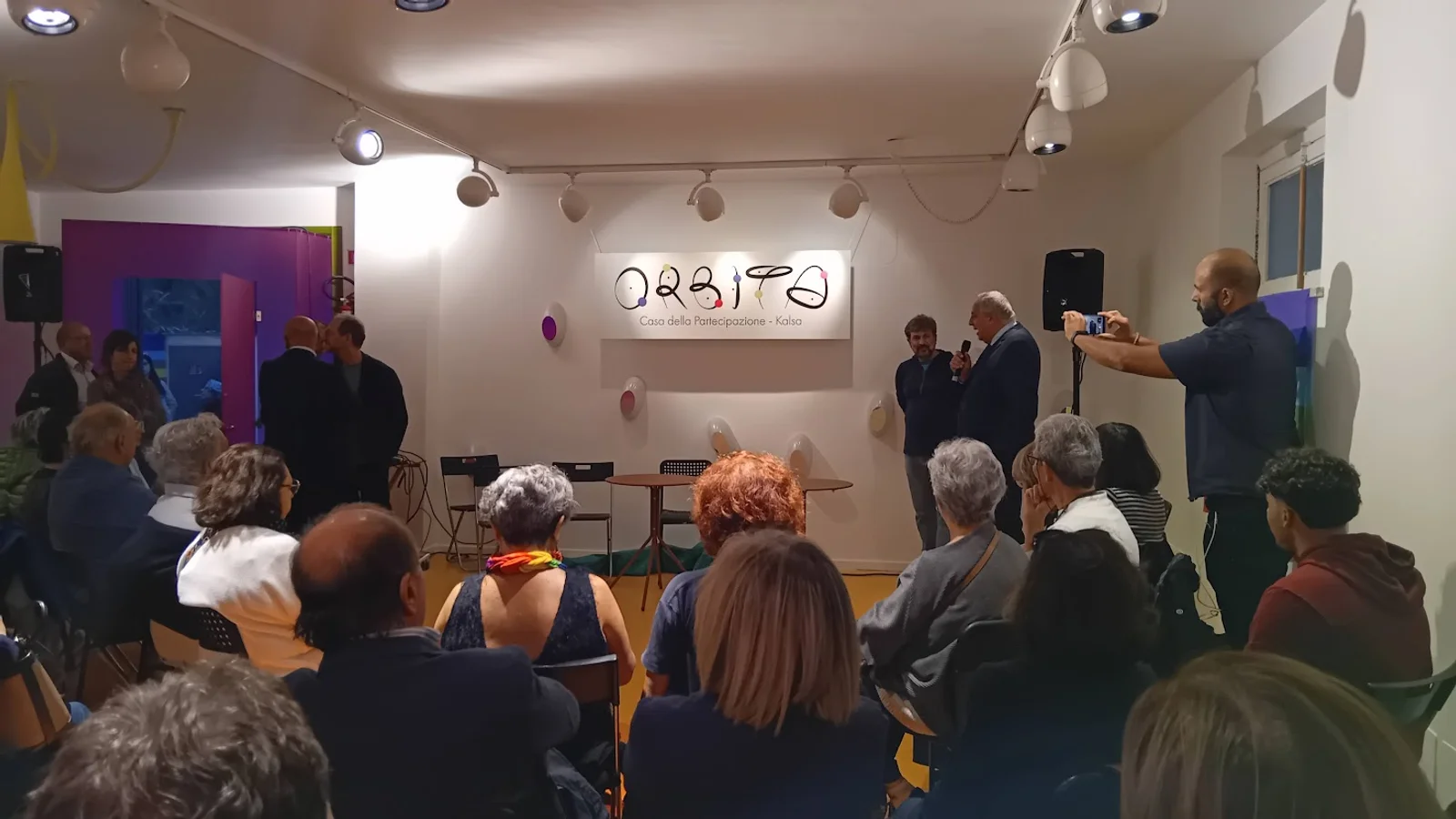
It all starts on 20 April 2025, with the approval of the Collaboration Pact. On 15 May the keys arrive and the self-recovery works begin: weeding, painting, plumbing and electrical repairs, carried out together by volunteers and people serving community sentences — a construction site that is, in itself, an act of restorative justice. On 4 July we run a public consultation at Palazzo Ziino, "Spazio ai beni comuni," to map the Kalsa's real needs together with residents. On 3 October 2025 we cut the ribbon and give the project its name: Orbita. A few weeks later, on 25 October, we hold the first neighbourhood social lunch, with 100 people at the same table.
Orbita is built on do-ocracy and on an idea we call "Aula Diffusa" — the diffuse classroom: urban regeneration happens through active participation, dialogue between generations, and collective care for the neighbourhood. It's not a service centre — it's a permanent Laboratory of Democracy. Inside you'll find an information desk (30 cases followed on housing, welfare, criminal justice), a psychological support desk (21 cases involving minors and families), the Sportello Didattico tutoring desk that moved here from via Alloro 64, the Armadio Collettivo community wardrobe — where 100 people have already swapped clothes and items — five Book Club meetings, and the start of Caffè Vuci, an intercultural language exchange.
The restorative-justice chapter is maybe the most telling: 75 people serving community sentences involved in the "Trame di Legalità" pathways, 10 weekly teams cleaning the neighbourhood — from Foro Italico to Piazza Lolli. These aren't people "helped" by a service — they're people becoming an active part of caring for a space that, not long ago, was just as abandoned as they themselves risked being.
The project runs on a mix of resources — €15,000 from the Waldensian Church's Eight per Thousand fund, €8,000 from New Inherit under Creative Europe for refitting the space, €7,000 of our own resources for furniture and fittings — and on a partner network that, alongside neu [nòi] as coordinator, includes Idea e Azione for community justice, Teatro Atlante for social and artistic methods, Sguardi Urbani for urban research, plus UEPE, Arci Gay, Di sana pianta, Cesvop and Labsus.
Since January 2026 we've been consolidating the management model and rolling out specific training, and in April 2026 we won the You(th) Care fund to keep working with younger residents. In the end, Orbita applies to a whole neighbourhood the same logic that's run our coworking since 2012: a space, on its own, regenerates nothing. It's the people who decide to take care of it together that do.